5th Floor, West Tower, World Financial Centre
1 Dong San Huan Middle Road
Chaoyang District, Beijing 100020, China
Tel: +86 10 5081 5880




November 06, 2019
“SAIF Employment Report 2019” Shows New Records of Starting Salaries of MF a ...
Recently, Shanghai Advanced Institute of Finance (SAIF), Shanghai Jiao Tong University released the employment report of its Master of Finance (MF) and full-time Finance MBA (FMBA) graduates in 2019. In spite of the challenging employment situation, the graduates of these two programs continued to rise against the trend, and the average annual salaries rose to a new level, both hitting a record high. This year, SAIF MF Program saw a total of 86 graduates, an increase of 39 from the previous year, which are the first batch of graduates after the expansion of the Program. There are also 42 graduates from the full-time FMBA Program. In order to help students to find the optimal professional roadmaps, SAIF Career Development Center (CDC) builds on the education philosophy of customized advantage development, provides diversified employment opportunities and solutions and facilitates SAIF graduates fully demonstrate their excellent quality and professional skills in the fierce market competition, who have been generally favored by employers, with significantly increasing salaries. This year, 12% of SAIF MF graduates and 11% of SAIF FMBA graduates boast a starting annual salary of more than RMB800,000.
November 02, 2019
Sino-UK Fintech Summit Forum 2019 and Shanghai Fintech Industry Alliance Launche ...
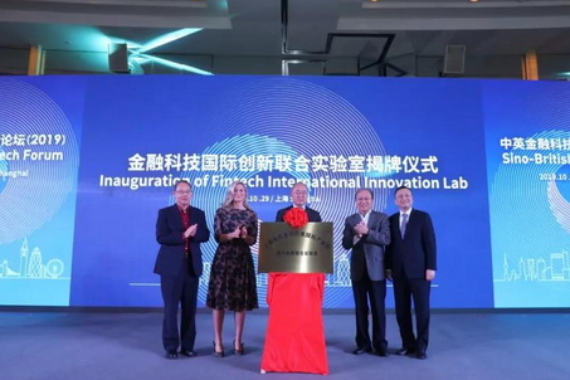
On October 29th, 2019, Sino-UK Fintech Summit Forum 2019 jointly hosted by Shanghai International Group Co., Ltd., Schroder Group and Shanghai Advanced Institute of Finance (SAIF), Shanghai Jiao Tong University and sponsored by Shinovation Capital Corporation Co., Ltd. was held in Shanghai. Prof. Jiang Wang, Chair of Faculty Council and Executive Director of the Board at SAIF, Prof. Chun Chang, Professor of Finance and Executive Dean at SAIF, Prof. Feng Li, Professor of Accounting at SAIF, Associate Director of China Academy of Financial Research (CAFR) and Co-Director of Shanghai Advanced Institute for Financial Research (SAIFR) and guests from the People’s Bank of China Shanghai Headquarters, Shanghai Municipal Financial Regulatory Bureau, Shanghai Hongkou District CPC Committee and District Government attended the launching ceremony. At the event, Shanghai Fintech Industry Alliance initiated by Shanghai International Group was announced. Under the guidance of the People's Bank of China Shanghai headquarters, the Alliance was proposed by Shanghai International Group in conjunction with 14 organizations in the sectors of financial factor markets, banks, insurance, securities, new finance and institutions. The members include China Foreign Exchange Trading Center, SPDB, Guotai Junan, Shanghai Insurance Exchange, Alipay and SAIF. Looking at the background of the members, it is obvious that the Alliance is consciously building up financial application scenarios, technical reserves and cutting-edge theories. The keynote speakers from regulators, Chinese and foreign financial institutions, industry associations and research institutions, focused on China's FinTech regulatory developments, UK’s FinTech innovation experience and trend analysis, China's banking FinTech practices and how traditional financial institutions shall embrace FinTech transformation, covering a number of key and hot issues in FinTech. Experts believe that traditional financial institutions shall take the initiative to embrace FinTech, give full play to the enabling role of FinTech, promote the deep integration of finance and technology, and achieve high-quality development of the financial sector. The Fintech Summit Forum is not only an ideological event in the FinTech field in China and UK, but also a valuable exploration to serve the construction of Shanghai as an international financial center and a startup center. The Forum provided a channel for clashing ideas and suggestions for regulators, industry organizations, experts and scholars, and contributed to the development of Shanghai’s FinTech sector.
September 16, 2019
SAIF and Charles Schwab Released the Latest “China Rising Affluent Financial W ...
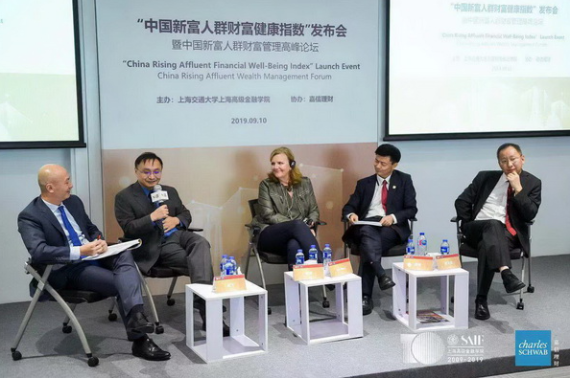
On September 10th, 2019, Shanghai Advanced Institute of Finance (SAIF), Shanghai Jiao Tong University and Charles Schwab jointly released the third edition of "China Rising Affluent Financial Well-Being Index", which aims to track China's rising affluent individuals, a group that has a growing influence on the Chinese and global economies, and their ever-changing perception of wealth. The latest edition in 2019 shows that even in the changing economic environment at home and abroad, China's rising affluent individuals remain confident in their overall financial well-being, in particular in traditional investments based on real estate investment and children's education. Meanwhile, there are certain differences in the financial literacy of rising affluent individuals in different regions, which will affect the achievement of their long-term financial goals. However, the growing popularity of digital financial services has opened a new way to improve the financial well-being of this community. "China Rising Affluent Financial Well-Being Index" is a joint effort initiated by SAIF and Charles Schwab, which is executed by Nielsen, an international expert of data monitoring and analytics, in terms of questionnaire design, data collection and index creation. Prof. Feng Li, Professor of Accounting at SAIF Associate Director of China Academy of Financial Research (CAFR), delivered a speech at the press conference and commented that the Index for the first time included Tier 3 cities in the survey in 2019, and compared the investment behaviors and preferences of the rising affluent individuals in China's Tier 1, 2 and 3 cities, in order to help financial professionals, policy makers and academic researchers better understand and further explore the characteristics and differences in investment behaviors. "The wealth management decisions of the rising affluent individuals not only affect their own future, but also have a bearing on China's development," stated Prof. Fei Wu, Professor at SAIF, at the press conference, “The current investment behaviors represent their past experience, that is, increasing reliance on savings and real estate investment. But this approach may be challenged by the changing macroeconomic environment."
September 06, 2019
SAIF and BOCOM Institute of Finance Signed Joint Education Agreement
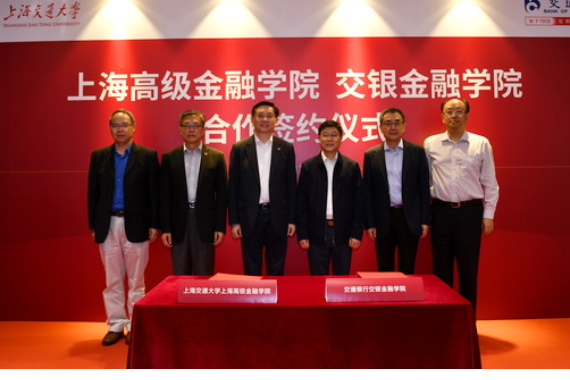
On September 3rd, a joint education agreement between SAIF and BOCOM (Bank of Communications) Institute of Finance was signed in Shanghai. Sixian Jiang, Secretary of the CPC Committee of Shanghai Jiao Tong University (SJTU); Guangshao Tu, Adjunct Professor of SJTU and Executive Director of SAIF; Deqi Ren, Deputy Secretary of the CPC Committee of the Bank of Communications; and Mang Guo, Member of the CPC Committee and Vice President of the Bank of Communications, witnessed the ceremony and delivered speeches. Chun Chang, Professor of Finance and Executive Dean of SAIF; and Yijun Wang, Executive Vice President of BOCOM Institute of Finance, signed the agreement and exchanged signed copies. Once this agreement comes into force, the two parties will make full use of their respective advantages and engage in a number of in-depth partnership initiatives, including: middle and high-end talent training, case studies, knowledge resource co-creation, teaching resource sharing, and joint branding and communication campaigns. The cooperation is aimed to facilitate the integration of industry, academia and research, and to drive the clustering and cultivation of financial professionals. The ceremony was followed by a closed-door seminar on Fin-Tech. Feng Li, then Professor of Accounting at SAIF; and Feng Liu, Deputy General Manager of IT Management Department of the Bank of Communications, shared their insights on the “Applications and Challenges of Technological Development in Banking” and “Prospects ofFin-Tech Development in Banking and BOCOM’s Technological Strategy”. Prof. David Li from SAIF presided over the panel discussion, during which the panelists presented their views on technological changes in the financial sector.
July 31, 2019
The 10th Summer Institute of Finance Conference Held in Ningbo
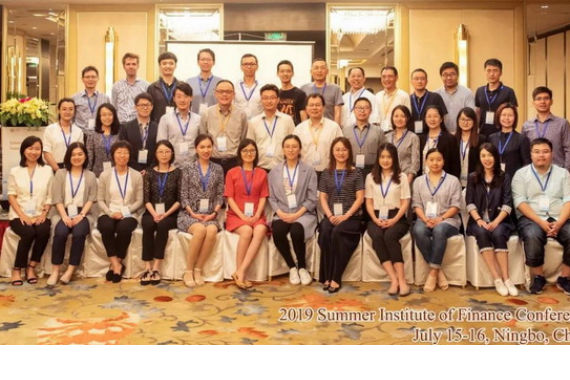
In July 2019, the 10thSummer Institute of Finance Conference (SIF), hosted by Shanghai Advanced Institute of Finance (SAIF), Shanghai Jiao Tong University (SJTU), was held in Ningbo. Nearly 50 scholars, professors and researchers from top universities and financial institutions from all over the world gathered in Ningbo to discuss cutting-edge topics of financial research. Prof. Nengjiu Ju, Professor of Finance at SAIF, served as Chairman of the Conference. Prof. Kewei Hou, Distinguished Professor at SAIF and Professor of Finance at the Max M. Fisher College of Business at Ohio State University, acted as Chairman of the Paper Review Committee. Prof. Hong Yan, Associate Dean and Professor of Finance at SAIF and Associate Director of China Academy of Financial Research (CAFR); Prof. Harold Zhang, Distinguished Professor of Finance at SAIF and Professor of Finance at Naveen Jindal School of Management at the University of Texas at Dallas; Prof. Peter L. Mitchelson, Distinguished Professor of Finance at SAIF and Professor at University of Toronto Rotman School of Management; Prof. Liyan Yang, SIT Investment Professor of Investment Strategy; and Prof. Songnan Chen, Professor at SAIF, attended the seminar. The event received 277 qualified submissions from all over the world, of which 12 papers were shortlisted. The event covered six topics, namely “Uncertainties”, “News Analysis”, “Banking System and Bank Run”, “Private Sector”, “P2P Lending”, and “Financial Market Anomalies”. During the day and a half event, the professors and doctorate candidates presented and reviewed the papers. Institutions represented included: University of Lausanne, IMD; Erasmus University in Rotterdam; Rutgers University Business School; Stockholm School of Economics; University of Toronto; University of Texas at Dallas; Indiana University; Ohio State University Fischer School of Business; Tsinghua University; University of International Business and Economics; Nanjing University; Zhejiang University; Central University of Finance and Economics; Fudan University; Hong Kong University; Hong Kong University of Science and Technology; National University of Singapore; SAIF; and other Asian institutions. Twelve professors and scholars shared their latest findings at the seminar, ranging from: the financial intermediary asset pricing model, the premium that increases uncertainty, the impact of TV commercials on real-time investor behaviors, the news dynamics to institutionalization, the licensing and asset pricing, and the dynamic model of banking system. They also explored whether the private sector can learn from the stock market, the valuation of mutual funds on private companies, and the analysis on social interactions and P2P loans. One of the papers discussed 231 abnormal performance patterns in China's A-share market. During the event, the scholars and professors made suggestions and conducted in-depth discussions on the issues of interest with the presenters and reviewers. The atmosphere at the site was warm and inspiring.
July 24, 2019
Prof. Zhan Jiang Won SJTU’s Educator Award
Shanghai Jiao Tong University (SJTU) recently named Prof. Zhan Jiang at Shanghai Advanced Institute of Finance (SAIF) as the winner of SJTU’s Educator Award, for her academic rigidity, coaching by example, excellent academic integrity and professional ethics highly recognized by the students. As one of the highest honors at SJTU, the Educator Award is developed to honor distinguished faculty members who have made remarkable contributions in teaching and talent cultivation and demonstrated the merits of “value-added” education. As one of the first full-time professors joining SAIF in July 2011, Prof. Zhan Jiang has played an indispensable role in SAIFs advancement in the fields of teaching, research and administration. Over the years, she has taught a variety of SAIF programs, including MF, MBA, EMBA and Executive Education programs, ranging from “Corporate Finance” to “M&A and Restructuring”, which are all highly praised by the students. In 2017, Prof. Jiang Zhan won the inaugural SAIF Teaching Merit Award for her exemplary teaching performance.

July 22, 2019
The 17th China International Conference in Finance Held in Guangzhou
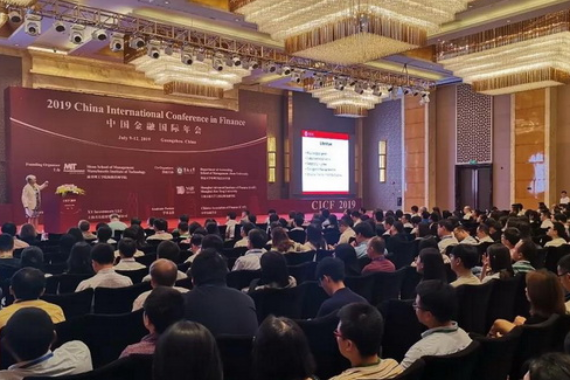
The 17th China International Conference in Finance (CICF) was held in Guangzhou from July 9th to 12th, 2019. CICF was founded in 2002 by the MIT Sloan School of Management and other organizations. This year, it was co-sponsored by Shanghai Advanced Institute of Finance (SAIF) at Shanghai Jiao Tong University (SJTU) and the Department of Accounting of the School of Management at Jinan University. It was attended by financial experts and industry leaders from all over the world. This year’s event has 894 registered participants, a record high. Prof. Jiang Wang, Mizuho Financial Group Professor at the MIT Sloan School of Management, Chair of SAIF Faculty Council and Distinguished Professor at SAIF, served as Chairman of the Conference. Prof. Xiaoyun Yu, Professor of Finance at Kelley School of Business, Indiana University and Distinguished Professor at SAIF, acted as Chairman of the Paper Review Committee at the Conference. Prof. Zhiguo He, Professor of Finance at the Booth School of Business, University of Chicago, served as Co-chairman. Prof. Chun Chang, Executive Dean and Professor of Finance at SAIF, attended the event and delivered a speech. The Conference invited Prof. Robert W. Purcell, Professor of Finance at Cornell University's Samuel Curtis Johnson Graduate School of Management, and Prof. Maureen O'Hara, from the University of Technology at Sydney, to deliver a keynote speech entitled "Market Ethics”. Prof. O’Hara's research demonstrated the role of ethical factors in the structure of financial networks. It revealed that ethical behaviors can survive given endogenous and rational choices, but only in the network architecture of certain clusters, and the stability of the behaviors depends on the structure of the financial network. Furthermore, corporate ethical behaviors can be effectively supported and guided through market design and regulation. A total of 1,325 qualified submissions were contributed by 2,907 authors, of which 255 papers were shortlisted. The authors of the selected papers were professors and doctoral students from major business schools around the world, as well as researchers from financial institutions and regulators. The conference lasted for three days, delivering 64 programs covering many frontier areas of the financial world.
July 10, 2019
2019 SAIF Commencement on SJTU Xuhui Campus
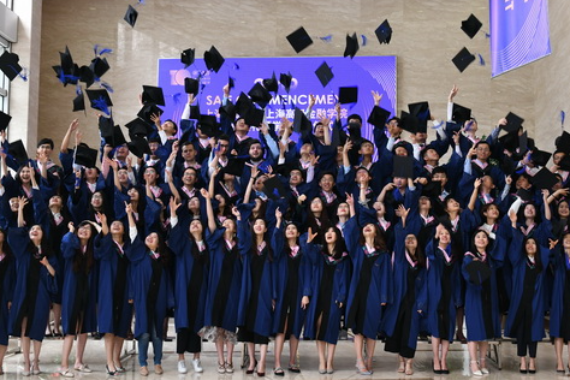
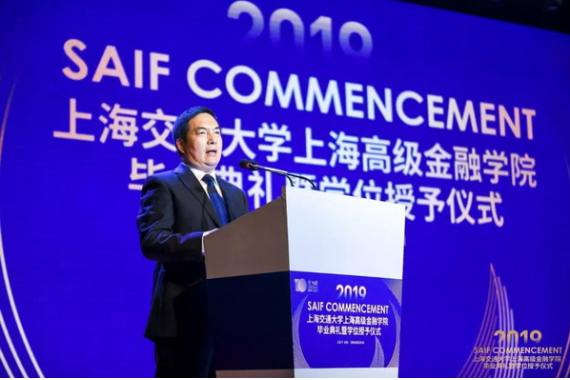
On July 6th, 2019 SAIF Commencement was held at the Wenzhi Auditorium on Xuhui Campus of Shanghai Jiao Tong University (SJTU), where 391 students graduated and set off on a new journey witnessed by both the faculty and their own families. The ceremony kicked off in the solemnness of the National Anthem. Zhen Huang, Vice President of Shanghai Jiao Tong University, extended his congratulations to the graduates and hoped that they would grasp the trends and opportunities of the times and contribute toward the evolution of China's financial sector. Jiang Wang, Chair of Faculty Council at SAIF, delivered a speech on behalf of the Institute. He mentioned that the great changes in the economic and financial domains at home and abroad imply exceptional opportunities for development and innovation, which provide unlimited potential for professionals and entrepreneurs to demonstrate their talent. He encouraged the graduates to seize the opportunities and make full use of their capabilities. Weihua Ma, former President of China Merchants Bank, acted as the keynote speaker. He pointed out that the practices of impact investment, bothprofitable and beneficial, represent a combination of public welfare and finance. He hoped that the graduates would engage in this segment and drive both China's sustainability goals and the practices of impact investment. The 391 graduates came from: SAIF Master of Finance (MF), Master of Business Administration (MBA), Executive MBA (EMBA), Global Executive Scholars (GES), and PhD Programs. Jiang Wang, Chair of Faculty Council at SAIF; and Chun Chang, Executive Dean of SAIF, turned the tassel for every graduate. This year, SAIF witnessed the largest group of graduates after the expanded enrollment of MF Programs. As of mid-June, all Chinese MF graduates were employed ¾dominated by fund and asset managers, brokers, and primary PE/VCs. Full-time SAIF MBA graduates were also widely recognized by the employers. As of June, the employment rate reached 91%. The employment profile was more diverse than in previous years, with visible growth in the positions of strategic investment, sales, wealth management, product, trading, and risk control. The commencement was presided over by Qigui Zhu, Secretary of the CPC Committee of SAIF. Lin Gui, Deputy Director of SJTU Graduate School; Hong Yan, Deputy Dean of SAIF; Shijun Cheng, Deputy Dean of SAIF; Jie Pan, Associate Dean of SAIF; and SAIF Professors Tan Wang, Hong Chen, Jun Pan, Yixuan Zhang, Zhan Jiang, Bing Han, and Kewei Hou also attended.
June 28, 2019
2019 International Conference on FinTech Launched at SAIF
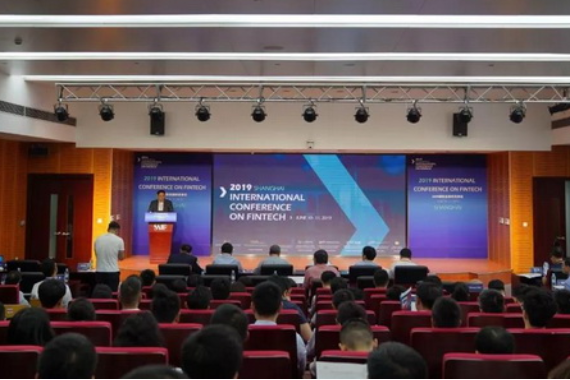
On June 10-11th, 2019 International Conference on FinTech was held at Shanghai Advanced Institute of Finance (SAIF), Shanghai Jiao Tong University (SJTU). It was co-sponsored by SAIF, China Academy of Financial Research (CAFR), CAFR FinTech Research Center, SJTU School of Mathematical Sciences, SJTU Artificial Intelligence Research Institute, the National University of Singapore (NUS) Suzhou Research Institute, NUS Research Institute of Risk Management, NUS Quantitative Finance Center and Digital Finance. The conference welcomed over 260 participants, including representatives from research institutions in China, the United States, Singapore, Germany, and Switzerland; leading FinTech companies in China; and traditional financial institutions at home and abroad. The two-day event consisted first day industry-oriented programs and second day academic discussion on the shortlisted papers. Prof. David Li, Professor of Finance at SAIF, Associate Director of CAFR, Director of CAFR FinTech Research Center and Chairman of the Conference, presided over the event. Prof. Chun Chang, Executive Dean at SAIF, Prof. Weidong Liu, Deputy Dean of SJTU School of Mathematical Sciences; and Prof. Min Dai, Director of NUS Quantitative Finance Center and Co-chairman of the Conference, addressed opening speeches. As one of the co-sponsors, CAFR FinTech Research Center was founded on April 20, 2019, dedicated to building a world-class think tank and an open research platform in the area of FinTech. It is a pioneer and promoter of theoretical and practical FinTech research in China and worldwide. It is committed to carry out research on policies, theories, methods, and applications in the field of FinTech to: drive FinTech-related academic and practical interaction; create an exchange mechanism and platform in line with international standards; cultivate high-end managers and professionals urgently needed by the FinTech industry; facilitate the integration of industry, education, and research” in FinTech; and build up a FinTech ecosystem. Prof. David Li, Professor of Finance at SAIF and Associate Director of CAFR, serves as Director of CAFR FinTech Research Center.
June 07, 2019
SAIF 10th Anniversary and Beijing Forum 2019
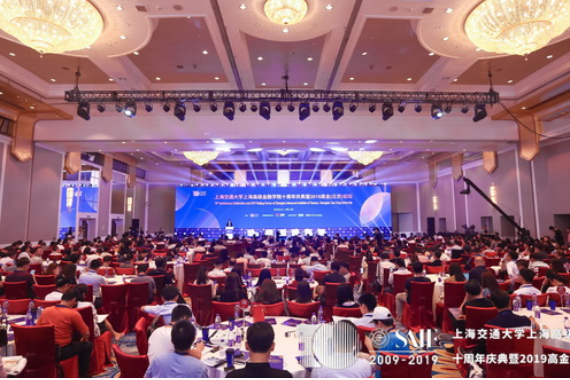
On June 15th, Shanghai Advanced Institute of Finance (SAIF) celebrated its 10th anniversary and held SAIF (Beijing) Forum 2019, which gathered leading economists and industry leaders from home and abroad. Paul M. Romer, 2018 Nobel Laureate in Economics and Professor of Economics at New York University; Guiping Liu, President of China Construction Bank; Jiang Wang, Chair of the Faculty Council of SAIF; Guoqiang Long, Deputy Director of the Development Research Center of the State Council; and Fang Cai, Vice President and Member of the Chinese Academy of Social Sciences, delivered keynote speeches. Chun Chang, Professor of Finance and Executive Dean of SAIF, addressed the gathering on behalf of the organizer. Ning Tang, Founder and CEO of CreditEase; Yonghua Lin, President of IBM China Research Institute; Jie Yang, General Manager of Pre-sales System Engineering Dept. of Dell Technology Group Greater China; Jianguang Shen, Vice President and Chief Economist of JD Digits; and Feng Li, then Professor of Accounting at SAIF, engaged in a panel discussion: “Technology and Innovation Drives Financial Development”. The panel discussion was presided over by Hong Yan, then Professor of Finance and DeputyDean of SAIF and Vice President of the China Academy of Financial Research at Shanghai Jiao Tong University. Jiange Li, Chairman of Sun Yefang Economic Science Foundation, concluded the event with his remarks. Jie Pan, Associate Dean of SAIF; and Ning Zhu, then Professor of Finance at SAIF, delivered speeches at the opening and keynote sessions, respectively. The 10th Anniversary Celebration Luncheon was held on the same day, attended by more than 100 guests, including: SAIF alumni, media, partners, and other stakeholders. Paul M. Romer and Yongding Yu made keynote speeches at the Luncheon and communicated with guests.

211 West Huaihai Road
Shanghai 200030, China
Tel: +86 21 6293 3500
9th Floor, Building T6, Hongqiao Hui
990 Shenchang Road
Shanghai 201106, China
5th Floor, West Tower, World Financial Centre
1 Dong San Huan Middle Road
Chaoyang District, Beijing 100020, China
Tel: +86 10 5081 5880
1203 Tower 7, One Shenzhen Bay
Nanshan District, Shenzhen 518000, China
Tel: +86 755 8663 8815
© Shanghai Advanced Institute of Finance All Rights Reserved.


Top