On November 6, Kishore Mahbubani—Founding Dean of the Lee Kuan Yew School of Public Policy at the National University of Singapore, former Singaporean Ambassador to the United Nations, and former President of the UN Security Council—delivered a keynote address at the SAIF Distinguished Speaker Series at the SAIF Greater Hongqiao Center. Under the theme "Navigating Uncertainty: Building a Shared Future Between China and the World," Mahbubani offered insights on the current global landscape and China's evolving role, engaging in substantive exchanges with SAIF faculty, students, and alumni.
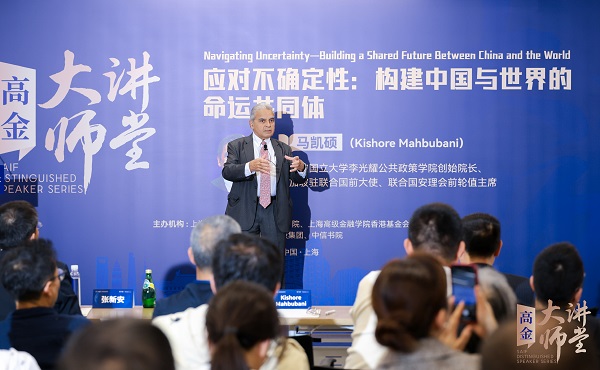
The event was jointly organized by SAIF and the SAIF Hong Kong Foundation, with special support from CITIC Publishing Group and CITIC Academy. In attendance were Xinan Zhang, Secretary of the CPC SAIF Committee, Tenured Professor of SJTU, and President of the Shanghai Behavioral Science Association; Hong Yan, Chair Professor of Finance, Deputy Dean, and GES Program Academic Director; and Nan Li, Term Associate Professor at SAIF and Deputy Director of the SJTU Institute of Securities & Finance. The event attracted over 400 attendees from diverse sectors.
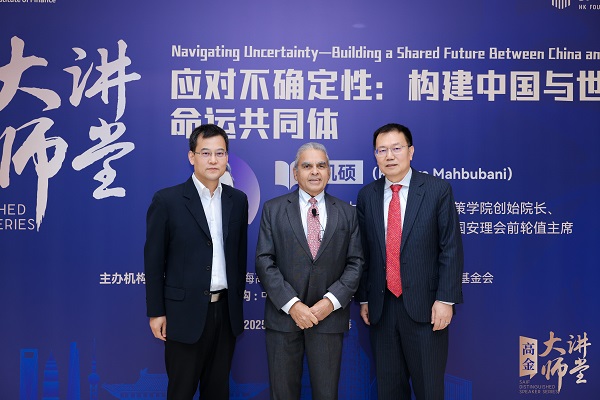
In his opening address, Professor Zhang outlined SAIF's founding mission to advance Shanghai's position as an international financial center and establish global leadership in finance research and education. He noted that amid growing uncertainty, SAIF has intensified its focus on Innovation Finance, Digital Finance, and Sustainable Finance—areas aligned with national financial policy priorities while driving innovation in talent development, research, and industry-academia collaboration. The SAIF Distinguished Speaker Series, he emphasized, serves as a vital platform for fostering dialogue and generating insight during times of global uncertainty.
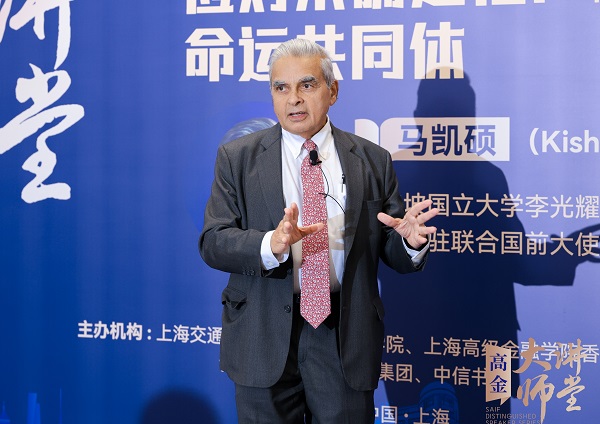
Drawing on decades of diplomatic experience, Mahbubani identified three profound structural shifts reshaping the world order: first, the world is shrinking at a dramatic rate; second, there is a massive shift of power from West to East, particularly in economic terms; and third, we are transitioning from a mono-civilization world to a multi-civilization world. These converging transitions, he argued, lie at the root of contemporary instability.
Mahbubani stressed that shared global challenges—from climate change to pandemics—demand renewed commitment to multilateral governance. "Our world is shrinking," he observed. "Over 8 billion people inhabit more than 190 countries, much like passengers sharing one ship. We must safeguard it." While multilateralism is increasingly essential, some Western states, he noted, remain reluctant to relinquish privilege in international institutions. Mahbubani expressed strong support for China's Global Governance Initiative as a timely contribution, urging the international community to collaborate in building a shared future.
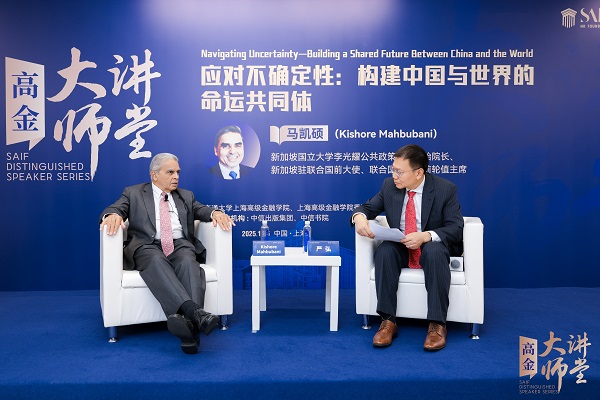
In a subsequent dialogue, Mahbubani and Professor Yan exchanged views on global governance reform, major-power competition, the rise of regional forces, and the international expansion of Chinese enterprises.
On global governance reform, Mahbubani noted growing disconnects between economic weight and institutional influence, underscoring the need for structural reform and sustained dialogue.
Regarding regional forces, Mahbubani described ASEAN, with nearly 700 million people, as a "postcard from the future"—a model of peaceful coexistence among diverse cultures and religions, offering lessons for inclusive global governance.
For Chinese enterprises expanding abroad, Mahbubani advised deeper local engagement, cultural sensitivity, and active participation in platforms such as the China International Import Expo to foster mutual understanding and achieve win-win outcomes.
Mahbubani further encouraged Chinese entrepreneurs and youth to engage globally, witness firsthand China's impact abroad, and consider how to refine the country's narrative on the international stage.
In his closing remarks, Professor Yan noted that the dialogue highlighted both the urgency and complexity of global governance reform, offering a strategic framework and practical wisdom for navigating an uncertain world. He emphasized that China should advocate for reforms in the global governance framework with greater openness and inclusiveness, upholding its responsibility as a major nation in building a global community with a shared future.